Ugly scenes marred the end of Tuesday’s AFC Champions League Elite semifinal between Machida Zelvia of Japan and United Arab Emirates’ Shabab Al Ahli — and it was perhaps understandable why the latter were infuriated by the manner in which they had just been eliminated from Asian football’s premier club competition.
Shabab Al Ahli’s hopes of becoming champions of Asia had just come to an end in the penultimate stage of the tournament with a 1-0 loss, but they were adamant that tie should have been headed for extra-time after their 92nd-minute equaliser was disallowed.
The U.A.E side immediately remonstrated with referee Shaun Evans. Then once more at the final whistle, where the Australian official eventually required a police escort off the field as he was surrounded by a mob of seething Shabab Al Ahli players.
Peculiarly, and perhaps for the first time ever, it was a substitution that led to VAR intervention which prompted Evans to overturn his original decision of letting Guilherme Bala‘s brilliant solo effort stand.
So, what exactly caused the controversy?
After Machida had seemingly made their fifth and final substitution of the tie, they immediately started making appeals to Evans the moment Shabab Al Ahli restarted play from a throw-in — although the reason behind those were initially unclear.
Shabab Al Ahli worked the way from one flank to the other, where Bala embarked on a dazzling 40-yard run and proceeded to skip inside two opponents before unleashing an unstoppable effort in the far corner.
It sparked wild scenes of celebration in the Shabab Al Ahli camp but, almost immediately, Machida continued their pleas to Evans.
And when VAR — upon conducting its mandatory check — called Evans to the pitch-side monitor, things became clearer.
As Machida’s Hotaka Nakamura was still on the field of play, briefly exchanging words with the man who was about to replace him in Henry Heroki Mochizuki, Shabab Al Ahli defender Kauan Santos had already thrown the ball back into play.
It then goes down to the minute details. Nakamura was as good as off the field with one foot almost on the touchline. Barely a second later, Mochizuki was charging onto the pitch.
It initially appeared that Evans had not sensed anything was amiss because of such a fine margin. And the rules are the rules.
Machida will defend the decision by arguing they were — quite blatantly — unprepared for the restart, especially considering he was replacing Nakamura at right-wingback — down the exact side where Bala produced his moment of magic.
Still, even if it had been a legal restart, he probably might not have made it to his designated position considering he had the entire width of the field to cover. Indeed, when Bala’s shot hit the back of the net, Mochizuki had only made it as far as the middle of the box — filling in the central role that was vacated by captain Gen Shoji‘s own covering of the aforementioned void down the right.
Obviously, teams are not obliged to wait till their opponents are completely ready — and in their designated positions — after substitutions. In the grand scheme of things, Bala would probably still have scored even if Shabab Al Ahli had waited that extra second before restarting play. The fact of the matter is they didn’t.
But here’s where it gets even more intriguing. Evans’ whistle could be heard being blown, calling for play to be restarted. Whether or not it came before or after Santos’ throw-in is — again — so marginal that it is a difficult to determine in real-time.
This bit is purely conjecture but, at the juncture of the game when teams are often suspected of bringing on players to take time of the clock, and with Machida taking a bit of time to complete their substitution, he may have — in an attempt to force the Japanese team to get on with the game — called for Shabab Al Ahli to continue proceedings.
So, when VAR decided that there was a serious missed incident that warranted an on-field review, it is quite possible that it was one that had actually been instigated by Evans himself. Even then, if he had decided to restart play prematurely because Machida were wasting time, then wouldn’t he have been well within his rights to stick by his original decision?
After all, there is no law in the game that decrees both teams must have 11 players on the pitch for the game to go on. Even discounting the scenario of sending-offs, numerical discrepancies are commonplace when players require medical treatment off the field.
Expectedly, Shabab Al Ahli coach Paulo Sousa — who vacated his dugout for the remainder of the contest after the disallowed goal — was indignant after the game.
“There was a goal that was scored and then it was cancelled — this is a very technical mistake by the referee,” said Sousa. “Unfortunately, this is what is turning football into rubble. It was a big mistake to choose this referee for this match.
“What saddens me is the organisation [the Asian Football Confederation] choosing referees who aren’t up to the quality of this tournament, these players, and the coaches present.”
“We deserved to be in the final and we deserve to play this important game.”
Of course, nothing can now change the outcome of the contest. It is Machida who are moving on to Saturday’s decider — a story in itself considering this is their tournament debut and they were still in the second tier of Japanese football as recently as in 2023.
Nonetheless, Shabab Al Ahli are well within their rights to be aggrieved that they did not at least have extra-time, or even penalties, to pull off a victory of their own.
Not for the first time, VAR has courted controversy. But perhaps for the first time, over a substitution.
What a weekend of European soccer! In the English Premier League, Manchester City beat Arsenal 2-1 to take control of the title race with just over a month to go; will we look back on Sunday’s game as the turning point? Erling Haaland (who else?) scored the decisive goal, and Kai Havertz missed a last-minute header from close range in a game that delivered on drama, quality and narrative.
Also in England, Manchester United defeated Chelsea to more or less seal their top-four finish at the Blues’ expense, which is a remarkable turnaround under interim boss Michael Carrick. Meanwhile, Chelsea are on the outside looking in and running out of games. Who deserves the blame for yet another underwhelming season? Liverpool‘s last-gasp derby win at Everton also bolstered the Reds’ quest for Champions League action next season.
Elsewhere, Bayern Munich sealed their latest Bundesliga title with a lot of squad rotation and a big win over Stuttgart, though this one under new-ish manager Vincent Kompany feels different than past successes. Real Sociedad clinched the Spanish Copa del Rey under U.S.-born boss Pellegrino Matarazzo, Juventus took another significant step toward a top-four finish in Serie A, and Paris Saint-Germain wobbled in Ligue 1, losing vs. Lyon to leave the door open for Lens to take this title race right down to the wire.
It’s Monday morning, so what better time for some musings? Let’s get into it.
Man City back in title race, but Arsenal look better than they have in a long time
The Gunners’ visit to Manchester City on Sunday was only going to provide definitive answers with an Arsenal win. Such a result would have left Pep Guardiola’s men nine points back with a game in hand — not quite done and dusted and not enough to quell the Gunners’ nerves, but to most observers, pretty darn close to “game over.” Instead, with City’s 2-1 win, we’re on the proverbial knife edge, with matters potentially coming down to goal difference. (Let’s hope not: It is such a silly and inconsequential metric with which to determine something as important as a league title.)
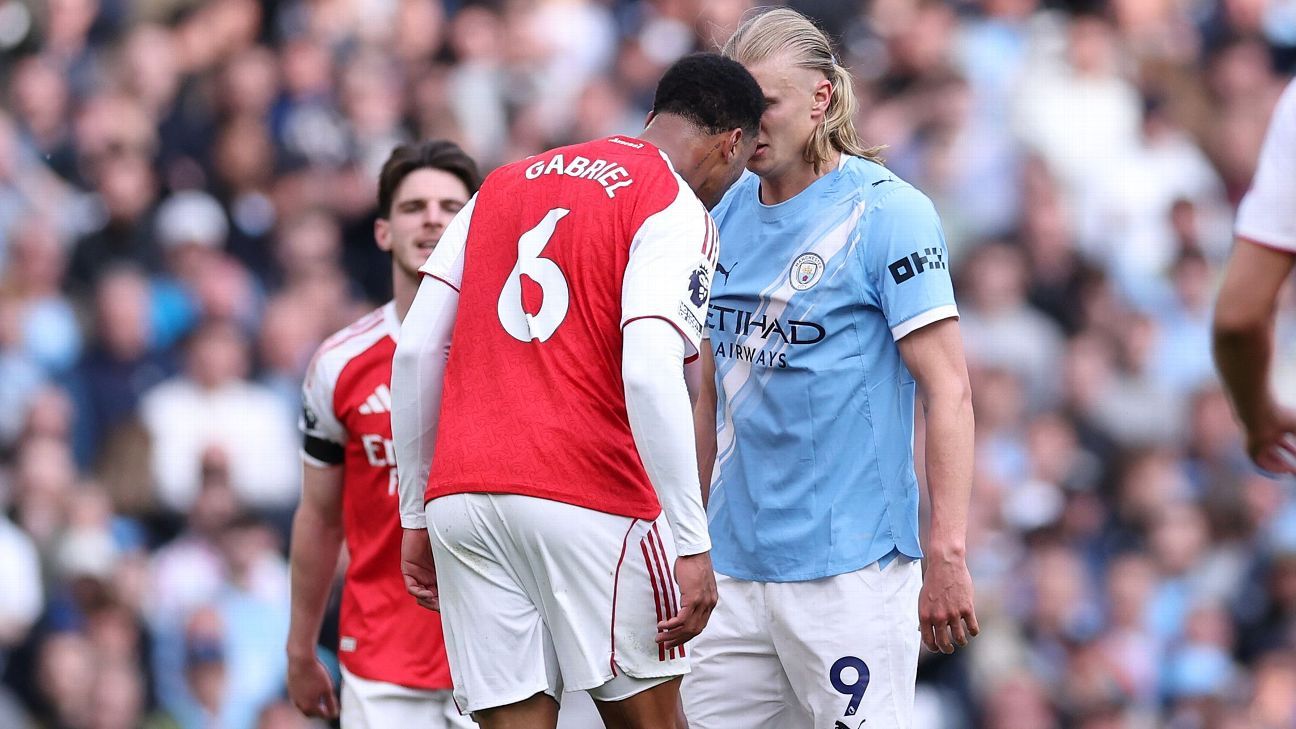
Games like these, with so much at stake, often disappoint. Fear and conservatism rule, and individual incidents are often the deciding factor. This wasn’t like that exactly, though there were plenty of game-turning moments, from Gianluigi Donnarumma’s blunder to the Gabriel-Erling Haaland incident that could (and probably should) have seen the Arsenal defender sent off, to the many chances spurned to the four times (two each) that the woodwork was rattled.
Pep Guardiola played his strongest available, front foot XI — the 4-2-3-1 with Rayan Cherki in the hole that took him four months to identify — and went for it. It was no surprise, as City needed the win; but what did surprise was the approach of Mikel Arteta, who made some huge calls, like starting Kai Havertz over Viktor Gyokeres. Some of us advocated this for some time, but the big Swede had been permanently first-choice even after Havertz’s return from injury. With Bukayo Saka out, Arteta also opted against a traditional winger and played Eberechi Eze wide while starting Martin Odegaard, who had missed the past two games, had been hampered by injuries, isn’t having a great season and last played 90 minutes in 2025.
Each of those decisions made sense. With Piero Hincapie and Cristian Mosquera (instead of Jurrien Timber and Riccardo Calafiori, both of whom were unavailable), Arsenal had de facto center backs in the fullback roles, and because neither is a standout on the ball, playing out against an energetic press can get tricky (and dangerous). Adding Eze, Odegaard and Havertz gives you ballers up the pitch and allows you to play more of a possession game. Shaking up a side that really hadn’t played well in two months also made sense.
The problem is, each move was also risky. Odegaard might have hobbled off injured in the first half. Eze might have been isolated on the wing. Havertz might have had one of those days where the barn door shrinks to the side of a microchip. More importantly, Arteta asked his team to play a different sort of game, which isn’t easy to do when you’ve played a different way (and had success) for much of the season. And if you get it wrong and get spanked, confidence starts to wane, you look really silly and get called an “overthinker” or “tinkerer,” and the season goes down the drain. (Look at Arne Slot and his back three in the Champions League.)
play
0:54
Leboeuf: Arteta will be to blame if Arsenal don’t win the title
Frank Leboeuf says mistakes from Mikel Arteta have allowed Manchester City back into the Premier League title race.
Arsenal lost, but they were by no means outplayed. That’s why performance matters, and why Arteta doesn’t seem foolish when he says his team are “more convinced than ever.” A game like this sets a platform of what Arsenal can do not just in the Premier League, but in the Champions League as well.
Still, City have the momentum now, and Guardiola once again has shown the ability of finding the framework that allows individual talent to shine at the right time. Witness Cherki’s breath-taking opener, or Nico O’Reilly’s assist for Haaland.
Speaking of Haaland: He managed just six touches in the opposition box, and four of them were shots, at least two of which he probably could have done better with. But he was there when it mattered, scoring the second goal, and his running battle with Gabriel, coupled with some sterling defensive work, helped define the game. If you really want to nitpick, he should have gone down during the Gabriel incident … but I’m glad he didn’t.
A word, too, on Donnarumma: His heavy touch gifted Arsenal the equalizer within a minute of City taking the lead. Athletes, at all levels, are told to shake off mistakes and focus on what comes next. It’s easier said than done. In his case, he came back with a superb stop to deny Havertz and the foresight to cue up the move that led to the Haaland goal.
A win over Burnley on Wednesday night will see City pull ahead of Arsenal at the top of the table, whether on goal difference or on goals scored. From there, as Arteta says, it’s a “five-game season” for all the marbles. Who’s taking it? No clue. As a neutral, I’m just grateful for what both clubs delivered Sunday.
Bayern Munich seal title with emphatic win
OK, we knew Bayern would win the title, so this isn’t much of a surprise. But the way they did it, with eight changes to the team that knocked Real Madrid out of the UEFA Champions League last midweek, roaring back as they did with four goals after conceding the opener, was pretty remarkable. The fact that they could swat aside with such ease a Stuttgart side still gunning for a top-four finish speaks volumes about this club and the way Vincent Kompany has them humming.
When I saw the starting XI — Luis Diaz, Josip Stanisic and the indefatigable Joshua Kimmich were the only holdovers from the Madrid second leg — I figured it might be one of those days when you drop points, but still celebrate at the end. Was I wrong. It was as if the early goal from Stuttgart’s Chris Fuhrich only made Bayern see red as they dominated the rest of the way, before conceding in garbage time to seal the 4-2 result.
play
1:03
Kane reflects on Bayern Munich’s ‘fantastic’ Bundesliga title win
Harry Kane speaks after Bayern Munich’s 4-2 win over Stuttgart secured the Bundesliga title.
Kompany’s changes were inevitable considering their heavy legs after the Madrid game and with the German Cup semifinal against Bayer Leverkusen coming up Wednesday, but it didn’t feel as if they were just about resting players and avoiding injury. The likes of Jamal Musiala, Alphonso Davies and maybe even Nico Jackson and Leon Goretzka may yet have their say between now and the end of the campaign, and you feel Kompany wants to encourage competition for places. Beyond that, no matter who plays, the relentless mentality is unchanged (4.33 xG tells its own story).
Kompany, who, lest we forget, was far from the first choice as manager and was coming off relegation at Burnley, deserves a huge amount of credit not just as a coach, but as the face of the club. It’s easy to say that anyone can win the Bundesliga with Bayern — they’ve won 13 of the past 14 seasons — but Kompany feels different, perhaps because he did it without the résumé (at least as a coach).
Beyond that, Bayern have already broken the single-season goals record — they’re averaging 3.63 a game in the league and no, that’s not a typo — and can still equal the points record. And of course, they’re on course for the Treble. Sure, we can crack jokes about the lack of competitiveness among the rest of the Bundesliga (though before we get too snarky, let’s remind ourselves how dominant Manchester City, Paris Saint-Germain and the two Spanish giants have been in recent history). But let’s recognize the fact that Bayern have taken their plentiful resources and really made them count. Not every one-percenter does that.
Luck turns against Chelsea as Manchester United win
play
2:31
Does Michael Carrick deserve to stay at Man United next season?
The ‘FC TV’ crew react to Manchester United beating Chelsea 1-0 in the Premier League.
On the pitch and off, there’s a very long list of problems at Chelsea, some the results of poor choices that might have made sense at the time, some needlessly self-inflicted, and some less so. On Saturday night, fans hoped a convincing victory over a marquee opponent like Manchester United might help turn the tide of negativity. They got the performance (to a point), but not the win, which in some ways makes things worse.
Chelsea hit the woodwork repeatedly, they won the xG battle (1.57 to 0.29) and they held United to a single shot on target. Unlucky for Chelsea, but that’s all the visitors needed as the quality of Bruno Fernandes and Mathias Cunha shone through in a 1-0 result. Unlucky? Sure, but that’s the way this low-scoring sport works.
The numbers are pretty horrifying. Six defeats in their last seven (all competitions). Their last home league win was in January. In all competitions since Feb. 7, they’ve won one game against top-flight opposition, and now they’re part of a grab-bag of teams chasing Liverpool for that fifth Champions League spot. Manager Liam Rosenior carries the can, because that’s how football works and owners think, but the issues run far deeper, and on Saturday, he seemed jinxed as well.
As for United, the win was huge (in implication) and minimalist (in execution). The gap over sixth place is 10 points with five games to go, so barring divine intervention, next season will see Old Trafford host its first Champions League game since 2023. That means more revenue and a platform on which to build, whether with Carrick as manager or somebody else. It also takes some heat off Jim Ratcliffe as his clock continues to tick down. They offered little on the pitch, but with four center backs out (Matthijs De Ligt and Leny Yoro injured, Lisandro Martinez and Harry Maguire suspended) you’re not going to blame them for being cautious and reactive. They have one goal left this season, and they’re getting there.
play
2:56
Laurens: Chelsea fans have turned on Liam Rosenior after defeat vs. Man United
The ‘FC TV’ crew react to Manchester United beating Chelsea 1-0 in the Premier League.
Quick hits
10. Pellegrino Matarazzo becomes the first American coach to win silverware in the Big Five European leagues: Jesse Marsch, of course, had won plenty at FC Salzburg (but then so had the guys who came before and after him — such is the stature of the Austrian club domestically). Yet Matarazzo made history on Saturday when his Real Sociedad side beat Atletico Madrid on penalties to win the Copa del Rey. Not just because it was the first trophy for an American in one of the Big Five leagues, but also because Real Sociedad aren’t a Spanish powerhouse like Real Madrid or Barcelona. (In fact, other than a COVID-era Spanish Cup, they had won nothing since the 1980s.) Throw in the fact that he took over the team only in December when Real Sociedad were near the relegation zone, and it makes the feat only even greater.
Against an Atletico side perhaps a bit spent from their Champions League efforts against Barcelona in midweek, Real Sociedad twice took the lead and were twice pegged back (the second, just seven minutes from time) after a superb strike from Julian Alvarez, who is regaining form at just the right time. Both had their chances in extra time: Alvarez hitting the post and Orri Oskarsson squandering a huge opportunity. Then came penalties and the usual battle of nerves when Unai Marrero, the backup and “cup” keeper, made all the difference. They’ll be talking about this one for a long time in San Sebastián and hopefully, folks in the U.S. will take notice of what one of their own is achieving at the highest level.
play
3:04
What went wrong for Atlético Madrid vs. Real Sociedad?
The ‘FC TV’ crew react to Real Sociedad beating Atlético Madrid on penalties in the Copa del Rey final.
9. Yan Diomande delivers again and RB Leipzig takes huge stride toward UEFA Champions League: I’ve raved about him before, but Diomande, at 19, may be the most productive non-Bayern player in the Bundesliga. Nobody — other than the Bavarian trio of Harry Kane, Michael Olise and Luis Diaz — has more goal involvements (goals+assists) than Diomande does (18). His opener against Eintracht Frankfurt on Saturday was highlight-reel stuff, cutting from right to left, all the way across the penalty box, evading tackles along the way and then unleashing a right-footed finish. Diomande’s skill set — quick, close control, mazy dribbler and two-footed — has had scouts drooling for a while, but he was seen as a “raw talent” a year ago and there were doubts whether he could go to the next level.
I think his production has already answered that question. Whether he stays there, or how much higher he goes, remains to be seen, but it’s worth remembering that less than 18 months ago, he was at an academy in Florida. Give him time to grow. In the meantime, Leipzig’s 3-1 win in Frankfurt all but guarantees they’ll be playing their European football on Tuesdays and Wednesdays next season.
8. Virgil van Dijk rescues Merseyside derby for Liverpool: And, possibly, the season. Because while no Liverpool fan will remember the 2025-26 season fondly, his buzzer-beating three-pointer should mark the turning point that will take Liverpool back to the Champions League next year. No, they’re not there yet and the run-in — Manchester United and Aston Villa away, Chelsea at home — is far from comfortable, but a seven-point gap over sixth place with five games left is pretty darn big. And now it’s about managing the situation more than it is fighting desperately to right the ship.
Of course, the operative word is “should” and, to be fair, on the evidence of the 2-1 win away to Everton in the derby, there are plenty of reasons to be skeptical. Hugo Ekitike is out for the season, Alexander Isak is still a shadow of himself, Beto gave Van Dijk and Ibrahima Konate fits on more than one occasion. But this was a big, backs-against-the-wall win. Mohamed Salah scored and made it clear he won’t go quietly; nor will Andy Robertson. Things weren’t supposed to turn out this way, but they did, and it’s much easier to reset and rebuild when you’re playing in the Champions League. That’s the least Liverpool fans can demand of their team between now and the end of the campaign.
play
1:43
Michallik: Liverpool in need of ‘overhaul’ despite derby win
Janusz Michallik says Liverpool’s late Merseyside derby winner can’t mask the problems within Arne Slot’s squad.
7. Jonathan David paves the way for Juventus as a top-four finish is near: It’s not beating Bologna, per se, that ought to give Juventus fans (cautious) confidence looking ahead to next season. They were at home, the visitors had played Europa League football on Thursday night and they had nothing to play for in Serie A — anything other than the three points would have been a shock. It was the spirit they showed and the performance they uncorked in a first half that should have seen them up by several goals.
As we’ve written many times, a top-four finish and Champions League participation is imperative to the club’s future. But limping across the line with more questions than answers is very different than finishing strong, with a clear identity, and that’s what Luciano Spalletti has given them (despite my early skepticism). David’s goal is a plus. He had endured a difficult campaign and suffered through plenty of criticism. The pressure of needing results hasn’t helped him settle either, but there’s a real player there and Spalletti knows it. Working on David, rather than blowing whatever (meager) transfer budget the club scrapes together on yet another veteran center forward, makes sense.
6. A wild 30 seconds confirms that Unai Emery is still the miracle man: Soccer, eh? With four minutes to go, Aston Villa were 3-1 up at home against Sunderland, whom they had limited to 0.29 expected goals. Mission accomplished? Not quite, because in the space of 60 seconds, it was 3-3. Emery looked paler than he usually does, and Villa Park was stunned. Then, in injury time, it looked to get even worse because Habib Diarra burst through on goal, one-on-one with Emi Martinez, and it looked like three points for Villa had turned into no points. Except the World Cup winner got a big paw to the ball, Villa raced up the other end, Lucas Digne crossed and Tammy Abraham flicked in the winner. Not stuff for the faint-hearted.
Emery joked afterward that he needed a day off. He also needs a statue built outside the ground. Because to achieve what they’re achieving — joint-third in the league and through to the Europa League final with a financially hamstrung club fined by UEFA and subject to a belt-tightening settlement agreement — is pretty remarkable. You might even call it a minor miracle.
play
1:47
Where can Borussia Dortmund improve next season?
Archie Rhind-Tutt and Thomas Hitzlsperger discuss how Borussia Dortmund can improve as their form fades towards the end of the season.
5. VAR cruelty as Hoffenheim keep UEFA Champions League hopes alive: It was classic “common sense” VAR stuff of the sort that causes even a major proponent like myself to second-guess. Borussia Dortmund’s over-sized center back Niklas Sule got his studs caught in the turf and fell over (suffering another bad injury in the process) just as Andrej Kramaric unleashed a goal-bound shot. Sule’s arm shot up in pain and deflected the ball as he collapsed to ground. It was obviously unintentional and, indeed, everyone’s main concern was for Sule, a player desperately unlucky with injuries over the years. Referee Daniel Siebert didn’t intervene, but the VAR called him to the screen and at that point, he had no choice: unnatural position, arm away from your body, it was black-and-white, no matter how unfair it feels.
Chalk it up to the unintended consequences of standardizing criteria rather than giving officials discretion. But it’s a discretion we can’t afford, because media, fans, players and coaches aren’t grown up enough to handle it. And if we give refs discretion, we end up having to deal with accusations of bias and recrimination whenever we don’t like the call. As for the game itself, Hoffenheim won 2-1 with two Kramaric penalties (they got a second one deep in injury time). You could tell it mattered far more to them than Borussia Dortmund, who really have nothing to play for at this point.
4. Small margins hurt Tottenham, but there’s life in them yet: In some ways, you couldn’t have scripted a worst weekend for Spurs. They gave up a last-minute equalizer that cost them two points and two of the three teams above them — Leeds United and Nottingham Forest — won to pull away from the pack while the other, West Ham, plays Monday night. This is where Roberto De Zerbi has to be clever to pull out the positives and work on them.
Maybe saying they can “win their last five games” (like he did after the 2-2 draw with Brighton) is a bit over the top, but it’s the sort of messaging coaches have to turn to at this stage. Compared to his debut, the 4-2-3-1 setup, with Xavi Simons in a starring role, was far closer to what you expect from a De Zerbi side. They created chances and held their own against a Brighton team under zero pressure (which is not to be taken for granted) and, ultimately, they were beaten only by an individual mistake: anyone can have the sort of moment Kevin Danso had. The run-in is pretty brutal on paper, filled with opponents with plenty to fight for, which is why I can’t be confident they’ll stay up. But I’m pretty sure that if they play like they did Saturday, they will give themselves the best possible chance of avoiding the drop.
play
1:16
Laurens: Spurs showed more heart and intensity in Brighton defeat
Julien Laurens says relegation-threatened Spurs’ next fixture league against Wolves is “the must of the must wins”.
3. An ugly win for Milan at Verona, but credit to Mike Maignan: The three points were all that mattered, and we got an outcome that matched that from Milan. There wasn’t much in the way of quality — other than Rafa Leao’s assist for Adrien Rabiot’s goal — or attacking intent, a couple of decisive Maignan saves and a win. Should we be expecting more at this stage of the season against an opponent which is now 10 points from safety and has won once since mid-December? Of course, but such is the narrative that many still reckon it has been a fantastic season.
That said, Maignan stood out once more for his leadership. Leao was reportedly a target of racist chants in the first half by some Verona supporters. Most in the stadium might have missed it, including the referee and Maignan. When he found out what happened at halftime, he made it a point to inform the match official, who applied the protocol and issued a warning over the stadium PA a few minutes after the break. Maignan could easily have ignored it: by that point, it had long subsided. But you can’t let these things slide even if every time he touched the ball, he was roundly booed by the home supporters.
2. Luis Enrique’s calculated gamble backfires against Lyon … so is the Ligue 1 title race still on? It’s a valid question because, with four games in a nine-day stretch, Paris Saint-Germain made six changes (Ousmane Dembele, Marquinhos, Khvicha Kvaratskhelia and Joao Neves were among those who started on the bench) for the visit of Olympique Lyonnais to the Parc des Princes. The 2-1 defeat leaves them a single point clear of Lens, who won on Friday night. PSG do have a game in hand over their rivals, but there’s also the head-to-head clash to come, which means the margin of error is very fine indeed. The last thing Luis Enrique wants is to get to the Lens game on May 13 with the title still up for grabs, not least because PSG end the domestic season with a derby, away to Paris FC.
Still, I wouldn’t go overboard in blaming Luis Enrique’s choices here. PSG found themselves 2-0 down after 18 minutes after a Willian Pacho mistake (punished by Endrick) and a counterattacking goal. They were dominant the rest of the way (23 shots on goal and a 3.12 xG) and on a different day, with better finishing, you feel they would have gotten the result.
1. Napoli’s slim title chase ends in a whimper and Antonio Conte contradicts himself: With the Inter win on Friday night, Napoli had no real margin for error at home to Lazio: It was three points or bust. And they went bust, losing 2-0 (and with Mattia Zaccagni missing a penalty) against a side with nothing left to play for in the league. It’s hugely disappointing after all the chest-beating, especially since all the injured stars (which Conte brought up repeatedly all season long) were back and fit. And while it’s tempting to blame the defenders — yes, Alessandro Buongiorno was awful, again — when you can muster only 0.51 xG (and no shots on target) in a must-win game, it runs far deeper than that.
Conte took it on the chin, saying he should have done more psychologically to prepare, but then he added how all the rumors surrounding the club (“the more we keep our mouths shut, the better it is”) hurt his team. Really? Who was it who put his own name out there to begin with?
Video assistant referee causes controversy every week in the Premier League, but how are decisions made and are they correct?
This season, we take a look at the major incidents to examine and explain the process, both in terms of VAR protocol and the Laws of the Game.
Andy Davies (@andydaviesref) is a former Select Group referee, with over 12 seasons on the elite list, working across the Premier League and Championship. With extensive experience at the elite level, he has operated within the VAR space in the Premier League and offers a unique insight into the processes, rationale and protocols that are delivered on a Premier League matchday.
Referee: Anthony Taylor VAR: John Brooks Time: 83 minutes Incident: Possible red card for violent conduct
What happened: An altercation between Arsenal’s Gabriel and City’s Erling Haaland ended with the defender seemingly headbutting Haaland. Referee Anthony Taylor decided to give a yellow card to Gabriel, and the VAR did not intervene.
VAR decision: The VAR did not feel that a clear error had been made by the referee and confirmed the yellow card.
VAR review: VAR John Brooks would have taken the lead from the on-field communications from Anthony Taylor when reviewing this incident. Taylor’s view of the possible violent act by Gabriel and its subsequent contact was very credible, having all the information available to him, and he gave his rationale accordingly.
In law, a red card for violent conduct is considered when a player uses or attempts to use excessive force or brutality against an opponent when not challenging for the ball. However, such an action can be judged as a yellow card for adopting an aggressive attitude if the referee deems the contact as negligible.
This was the explanation given by Taylor, and the VAR did not fully disagree. In this situation and its specific circumstances, the VAR would not have looked to intervene and would have backed either a yellow or a red card based on the referee’s comms.
Verdict/insight: Let’s be clear, Gabriel is very fortunate to not receive a red card for violent conduct. His action in pushing his head toward Haaland in an aggressive manner was unwise, to say the least. Haaland’s ability to stay on his feet (many wouldn’t) certainly allowed Taylor the opportunity to manage the incident with a wider perspective.
The contact, in truth, probably wasn’t with excessive force, and therefore, you could argue a credible outcome was reached. However, it was a risk for Taylor, because if the game had a different outcome, his decision to give Gabriel only a yellow would have been a potential game changer.
In my opinion, Gabriel should have been sent off. It was an attempted violent act, and regardless of the level of contact or injury to his opponent, the action met the criteria for a red card.
– Liverpool lead the race to sign Crystal Palace midfielder Adam Wharton, TalkSPORT reports. Liverpool face strong competition from Manchester United and Real Madrid for the England international’s signature, while he is under contract at Selhurst Park until June 2029 and Palace are demanding a fee of at least £80 million.Curtis Jones‘ exit from Liverpool could help the club raise extra funds, and he has been linked with a move to Italian giants Internazionale.
– Arsenal are keen on signing Leicester City wonderkidJeremy Monga, as per The Telegraph. Monga, 16, has already agreed terms on a professional contract with the Foxes, but attention from the Premier League may yet complicate matters. The winger has played 25 times in the Championship this season, scoring once and grabbing a pair of assists.
– Newcastle United‘s asking price for the transfer of Anthony Gordonthis summer is around £80 million, according to iNews. Bayern Munich have serious interest in the winger and are expected to make a formal bid to sign him at the end of the season. The England international has also been linked with a move to Arsenal, while Liverpool are thought to be long-term admirers.
– Tottenham Hotspur have struck an agreement in principle to sign Bournemouth center back Marcos Senesi on a free transfer, TalkSPORT has revealed. The Argentina international is expected to make the switch to North London at the end of the season, once his contract expires, though Spurs potential relegation could complicate things. Indeed, the proposed transfer hinges on them staying up as Senesi is not prepared to play in the Championship, while Manchester United and Atletico Madrid are also tracking his development.
– Borussia Dortmund have internally discussed a move for West Ham United defender Konstantinos Mavropanos in recent weeks, Sky Germany reports. The 28-year-old is wanted by several Bundesliga and Premier League clubs after a string of impressive recent performances, and is reported to be “seeking a new challenge” so will push to leave the club at the end of the season, despite having a contract until 2028.
Expert take
ESPN’s resident scout Tor-Kristian Karlsen looks at Adam Wharton’s skill set.
Less than two years after making his debut, Wharton is now undoubtedly one of the Premier League’s most accomplished distributors of the ball. He constantly asks to receive it and is trusted not to lose possession under pressure. Then, once in control, his pass selection is outstanding: he can hit 35-yard switches with precision, incisive line-breaks through pressure, or well-weighted deliveries played into a teammate’s stride.
The quality of Wharton’s left foot is one standout feature, though it’s also his vision and ability to “map” the play around him that is key, as they allow him to move the ball at tempo with ease and fluidity.
Wharton has also shown he is comfortable in a high-intensity style of football. Under Oliver Glasner at Palace, the England midfielder has performed in an energetic, vertical scheme, where demands on speed of thought and defensive reactions are higher. Though he was impressive last season, he has lifted his key-pass output by roughly 10% this year, while still maintaining accuracy and pass variation. Crucially, the distribution isn’t location-specific either and he is as reliable starting attacks from deep as he is contributing in the final third.
Other rumors
play
1:29
Burley praises Lampard’s ‘amazing job’ after Coventry’s promotion
Craig Burley reflects on Coventry City’s promotion to the Premier League.
– Newcastle United are ready to cut their losses by letting striker Yoane Wissa leave the club at the end of the season for as little as £15 million after a disappointing £55 million transfer from Brentford. (iNews)
– Wolfsburg have reignited their interest in West Ham United striker Niclas Füllkrug. The Germany international is expected to return to East London this summer after AC Milan opted against activating his £5 million permanent option. (Sky Germany)
– Real Madrid midfielder Dani Ceballos, 29, is a target for Dutch club Ajax after falling down the pecking order in the Spanish capital. (AS)
– Defender David Alaba, 33, is expected to leave Real Madrid when his contract expires at the end of the season. (Fabrizio Romano)
– AC Milan are among the clubs monitoring Sporting center back Ousmane Diomande. (Nicolo Schira)
– Bournemouth and Besiktas are tracking Internazionale winger Luiz Henrique heading into the summer transfer window. (Nicolo Schira)
– Eintracht Frankfurt and Roma are leading the race to sign Bayern Munich youngster Noël Aséko (currently on loan at Hannover), whose transfer is valued around €12 million mark. (Florian Plettenberg).
– Manchester City remain interested in signing Troyes youngster Mathys Detourbet, although no agreement exists between the two clubs at this stage. (Santi Aouna)
– Defender Jack Hendry will be leaving Al Ettifaq on a free transfer this summer. (Fabrizio Romano)
– Everton are expected to try to sign Al Ahli striker Ivan Toney this summer, as he is open to a Premier League return. (Ekrem Konur)
We still have a month to go in the 2025-26 season of the Premier League, but it feels like Arsenal‘s visit to Manchester City on Sunday will be the match that decides the destination of the title.
Mikel Arteta’s Arsenal have been top of the table since September as they bid to become champions of England for the first time since 2004, but City boss Pep Guardiola has pipped the team coached by his former assistant to the title twice in the last three years and his team remains close behind as we enter the home stretch this term.
Who will prevail at the Etihad Stadium? And how will the result affect the title race? ESPN’s Rob Dawson and James Olley run through the key points ahead of this crucial showdown.
What’s at stake in this game in terms of the title race?
Sunday’s meeting is the closest thing you can get to title decider in mid-April. City have the momentum, Arsenal have the points on the board. City have the pedigree from winning six of the last eight league titles, Arsenal have the relentless hunger of trying to end a 22-year drought. The irresistible force of City’s attack — featuring Erling Haaland, Rayan Cherki and Jérémy Doku — meets the immovable object of the best defence in the league, with Gabriel Magalhães and William Saliba among the best centre-back pairings the Premier League has seen. Something has to give.
Victory for City will move them within three points, and three days later they play their game in hand against relegation-battling Burnley. They could be top by then. That would leave Arsenal with a firm sense the trophy is slipping from their grasp. Conversely, a win for the Gunners would be transformative: nine points clear, City’s pride severely damaged and the title solely in their hands with just five games to play. A draw would leave Arsenal in the box seat but City still with an outside chance.
Matches are often victims of excessive hyperbole. This one isn’t. — James Olley
What happened in their previous meetings this season?
City and Arsenal have met twice already this season, registering one draw and one City win. September’s 1-1 draw at the Emirates in the League was notable for an apparent change in Guardiola’s usual tactics. Not one for being overly defensive, it looked like the City boss had instructed his team to ‘park the bus’ and wait for opportunities to counter-attack. It almost worked; after Haaland’s early goal, Arsenal only salvaged a point thanks to Gabriel Martinelli‘s 93rd-minute equaliser.
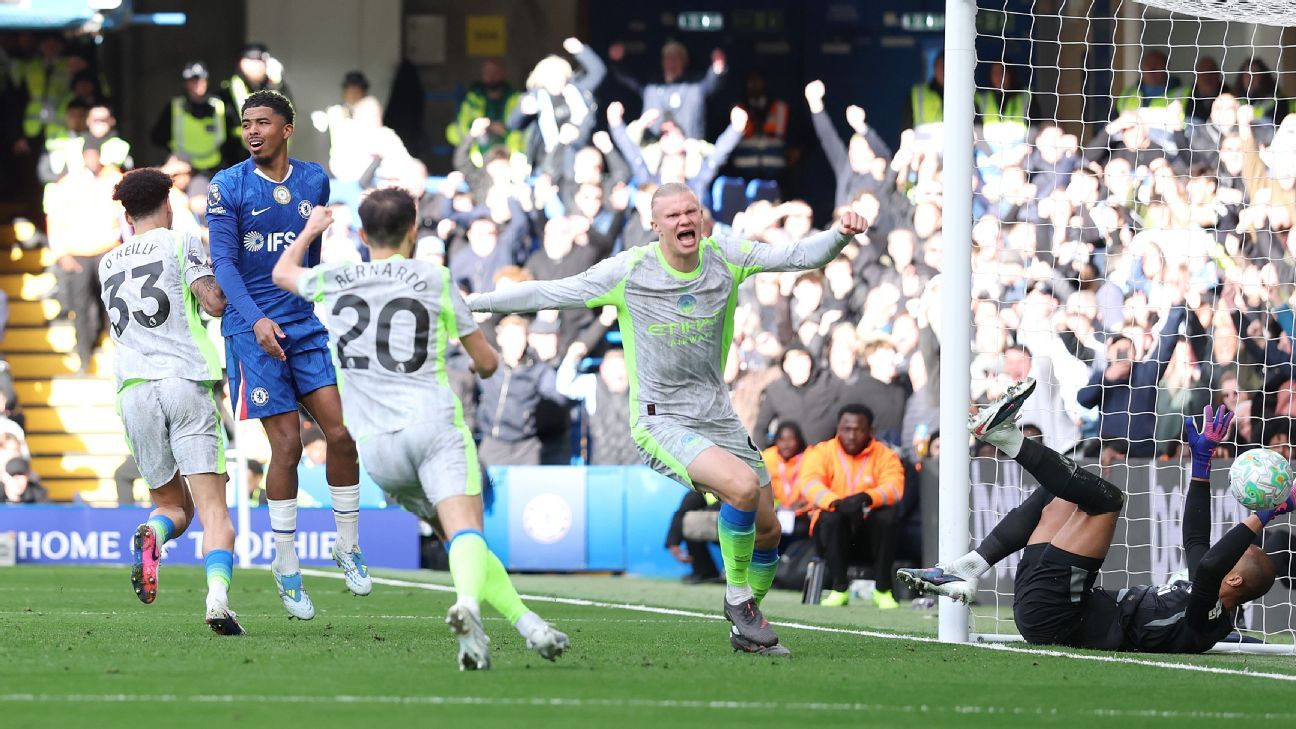
The Carabao Cup final at Wembley last month was more significant. City arrived on the back of a morale-denting UEFA Champions League exit to Real Madrid, while Arsenal were on the back of a 14-match unbeaten run stretching back to January. With the first trophy of the season on the line, the first half was tight and cagey. But while Arsenal adopted the same approach after half-time, Guardiola tweaked his game plan and City took control. Two goals from break-out England star Nico O’Reilly — the day after celebrating his 21st birthday — earned City a 2-0 win.
The respective form of the two teams since could not be more different. City have recorded comprehensive wins over Liverpool and Chelsea, scoring seven and conceding none. Arsenal, meanwhile, have played four and won just once. Ahead of Sunday’s meeting, one team is full of confidence and playing well and the other is not. — Rob Dawson
What to watch for on each team
Manchester City: Guardiola will know that Arsenal are vulnerable and he will look to take advantage. At least from the outside, it feels similar to Arsenal’s visit to the Etihad in April 2023. Arsenal kicked off in that game five points clear of City at the top of the table. But what was billed beforehand as a potential title-decider very quickly turned into a mauling. Arsenal were dealing with injuries and fatigue, and City made them pay. The opening to the game was so frantic and ferocious that Arsenal couldn’t cope. City went 1-0 up inside the first 10 minutes and scored again before half-time. It ended 4-1 and left Guardiola’s team two points behind with two games in hand. City went on to win their third consecutive title by five points.
The way the two teams are playing heading into Sunday, it’s easy to see the same thing happening this time. Haaland looks sharp again after a slow start to 2026 and Cherki is one of the most in-form players in the league. Arsenal aren’t scoring freely at the moment and they face a monumental task to keep those two, plus Antoine Semenyo and Doku, quiet at the other end. — Dawson
Arsenal: Arteta treats City with more respect than anyone else. Part of that is his admiration for long-time friend and former colleague Guardiola, as well as an acknowledgment that City have been the most consistently devastating team for the last decade.
As Arsenal have steadily closed the gap, however, that conservatism has led to some frustration that Arteta has not shown more attacking intent in this fixture. Two years ago, they arrived at the end of March and played out a 0-0 draw. Last season, they were 2-1 up before having Leandro Trossard sent off on the stroke of half-time. The Gunners did not even try to attack in the second half, with Arteta suggesting afterwards there was simply no other way of approaching the situation.
What does he do this time? Arsenal are not defending with the intensity and cohesion of earlier in the season, and merely trying to play for a draw here would only ramp up the criticism that Arsenal’s style is too cautious to actually win silverware. But opening up too much risks giving City’s in-form attacking players the space to define the game. It is a delicate balancing act but the level of intent Arsenal show will be heavily scrutinised with many believing now is the time for the Gunners to seize their moment and win a game of this magnitude. If they do, they have one hand firmly on the trophy. — Olley
Key clashes
Gianluigi Donnarumma vs. Gabriel: This is a left-field choice given they won’t be near each other very often, but it’s a game that could be decided by City’s goalkeeper and the Arsenal defender. The Gunners’ big threat is from set-pieces — particularly if they’re not creating much from open play. Gabriel is an expert in those situations, and the onus will be on Donnarumma to deal with the danger.
If the giant Italy No. 1 can command his penalty area — punching or catching balls swung into the box from free kicks and corners — then a large part of Arsenal’s threat will be nullified. If Arsenal don’t score, then City will win. If, on the other hand, Arsenal can make the most of their set-pieces and Gabriel is allowed to cause chaos in City’s penalty area, then Arsenal will have a good chance of edging a fixture which could be decided by very fine margins. — Dawson
Declan Rice vs. Rodri: Rodri has struggled to consistently reproduce his best form since returning from a serious knee injury but his Carabao Cup final performance — particularly in the second half — was a masterclass. The 29-year-old remains pivotal to establishing the control City need in games to produce their best, and Rodri helped overwhelm Rice and Martín Zubimendi at Wembley.
Rice defied all expectations to play in the second leg of Arsenal’s Champions League quarterfinal against Sporting CP by overcoming illness to play the entire 90 minutes. The England international assumed the captaincy, too — keep an eye on if he retains that at Etihad Stadium as another sign of his growing importance. But if there is one lingering doubt about Rice, it is his ability to dictate and decide games of this magnitude on a regular basis. There have also been signs of fatigue after another gruelling campaign, but Rice has a phenomenal capacity to absorb that workload. Getting the better of Rodri on Sunday would go a long way to securing the win — and the title — he craves. — Olley
play
0:36
Guardiola: Title race ‘over’ if Arsenal beat Manchester City
Pep Guardiola looks ahead to a huge clash in the Premier League title race as Manchester City host Arsenal.
What the managers say
Pep Guardiola, Manchester City:
“If we lose, it’s over.
“They are so strong in all departments. Duals, physicality, if you allow them to make a good process by not being aggressive they make a good build-up.
“That’s why they are who they are. Top of the Premier League all season and that’s why I’m proud to be there and challenging them.”
Mikel Arteta, Arsenal:
“I’m not going to spend one second talking about that [playing for a draw]. We prepare every game to win, that’s why we are where we are and we’re going to continue to do the same.
“We have earned the right to be in this position, to be challenging and with the possibility to win and the opportunity to win on Sunday, arguably against the best team and the best manager that this league has ever seen.
“That’s a huge privilege, and we can’t wait to play the game, and we’re going to prepare the game to win it, that’s for sure, and we see that as a big opportunity for us.”
play
0:38
Arteta never got clarification on Haaland’s ‘stay humble’ comment
Mikel Arteta reveals he hasn’t spoken to Erling Haaland about when the striker told him to “stay humble.”
Predictions
Man City 3-1 Arsenal: The Gunners haven’t dealt well with the psychological punch of losing the Carabao Cup final. Damage-limitation mode is unlikely to work for long at the Etihad and everything points to a City win. — Dawson
Man City 2-0 Arsenal: City have the momentum, a clear week of preparation and home advantage in their favour. Arsenal can make it difficult for a while, but City possess the in-form individual quality to edge it. — Olley
Jeff Kassouf covers women’s soccer for ESPN, focusing on the USWNT and NWSL. In 2009, he founded The Equalizer, a women’s soccer news outlet, and he previously won a Sports Emmy at NBC Sports and Olympics.
Multiple Authors
The NWSL’s board of governors is expected to vote later this month on whether to flip the league’s calendar to a fall-to-spring season, multiple sources told ESPN.
The NWSL season currently kicks off in March and ends in November, but a change — one that has been debated for years and previously voted down — would see the season start in late summer and end in late spring. That would align the NWSL with many of Europe’s top leagues and soon, with MLS, which will make the transition to fall-to-spring next year.
The NWSL’s board has debated changing the season footprint for at least three years, and a flip of the calendar was narrowly voted down in late 2024, ESPN previously reported. Intense debate over the topic has continued within league circles.
Another vote on the calendar could happen at the upcoming board meeting, sources said, although the agendas to such meetings change frequently, and the terms of potential proposals can be altered right up until voting begins, as they did in December with the implementation of the new High Impact Player rule.
Even if there is a vote that successfully passes a calendar change — which is not guaranteed, since support of the idea is not unanimous — it could take years to implement.
An NWSL spokesperson declined to comment on this story.
NWSL commissioner Jessica Berman said in November that “our ecosystem is on notice” about the league potentially changing its calendar.
“There are certainly opportunities that can be created with us not overlapping Major League Soccer, in that the schedule congestion for our summer calendar will be mitigated,” Berman said before the 2025 NWSL Championship. “On the other hand, there will of course be other challenges that it creates in terms of understanding and knowing stadium availability.”
Proponents of the change believe that aligning the NWSL’s calendar with Europe will improve transfer business and allow the NWSL to better operate around FIFA international windows.
Sources told ESPN that there is also a belief among some board members that there is less competition for prime TV time in late spring and that the NWSL playoffs could have a larger audience in that window. Maximizing revenue from the next media rights deal is the NWSL board’s current top priority, multiple sources have told ESPN over the past year, and Berman has spoken about the topic frequently.
Critics of a calendar change point to the NWSL’s many cold-weather markets and potential player safety issues around holding games in frigid conditions, although extreme heat is already an issue during the NWSL’s summer months. They are also concerned about how cold temperatures and potential weather delays would impact attendance, which dipped on average last year.
The NWSL’s board of governors will meet later this month. Any potential league vote is likely to result in a narrow decision in either direction, as was the case in 2024.
MLS owners voted in November to flip the calendar and mirror Europe. MLS will make the transition by playing an abbreviated “sprint season” next spring before switching to a full season for 2027-28. MLS will begin its new seasons in July, take a winter break from mid-December through early February and finish the playoffs in late May.
The NWSL could follow a similar path but on a delayed timeline.
The NWSL’s new collective bargaining agreement, which was ratified in 2024, accounted for a potential change by eliminating restrictions to preseason start dates and by adding an entire section (27.9) accounting for a schedule format change. That section requires the league to provide no less than one year’s notice to the NWSL Players Association if it intends to switch to a fall-to-spring format.
After that, the CBA calls for the league and the union to form a scheduling committee and allow for NWSLPA input, as well as bargain over necessary changes that conflict with the current CBA, “but the NWSL retains the discretion to make the format change.”
There are natural breaks in the calendar for the NWSL to attempt a transition. The 2028 Summer Olympics will be in Los Angeles (and the Olympics soccer event spread across the U.S.), and the 2031 Women’s World Cup is expected to be primarily hosted in the United States, although the formal approval of that uncontested bid has been delayed by FIFA.
Changing the calendar has the support of many sporting executives across the league because it will put NWSL contracts at the same cadence as those in Europe, where deals typically expire in the summer. That, executives have said for years, will make player transfers easier.
In ESPN’s first anonymous general manager survey in 2024, one GM said that the intense debate over the calendar was “actually the biggest question facing the league.”
Turning the summer into the offseason would also allow the NWSL to avoid one of its largest headaches: international tournaments. The league tried to play through the 2015 and 2019 Women’s World Cups despite missing swaths of star players before finally taking a five-week break for the 2023 edition.
Between the World Cup, the Olympics and continental tournaments such as the Euros, there are major international calendar conflicts three out of every four summers. (And this year, in the one down summer in that cycle, the NWSL instilled a monthlong break because of the men’s World Cup taking over many of its venues and markets.)
MLS and the NWSL currently mirror each other in operating seasons that start at the beginning of the calendar year (usually February or March) and end with playoffs that run until the end of the year. MLS and the NWSL have both kicked off their seasons early in the calendar year since their inceptions in 1996 and 2013, respectively.
The USL Super League, which is also sanctioned as a U.S. women’s first division alongside the NWSL, launched in 2024 and already plays roughly a fall-to-spring schedule, kicking off in August and concluding in May.
MADRID — How confident was Hansi Flick of turning this UEFA Champions League quarterfinal tie around?
“Nine or ten [out of ten],” the Barcelona coach told Spanish TV before kickoff, undeterred by Atlético Madrid‘s imposing 2-0 first-leg lead.
And why not? When you’ve got Lamine Yamal, you’ve got every reason to be positive. The teenager is already so good, so decisive, so often, that it was no surprise to see him dominating this second leg at the Metropolitano right from the start, unfazed by the occasion or the atmosphere.
“Since I was a kid, I’ve taken on a lot of responsibility,” the 18-year-old said the day before the game. “I’m used to it. I don’t mind.”
Yamal’s first-half performance made the prospect of a comeback possible, putting Barça 2-0 up on the night and 2-2 on aggregate. But the hosts endured, as veterans like Antoine Griezmann and captain Koke were outstanding, and they found a way back.
“It was really hard for us at first today,” Koke said afterwards.
“But we were able to get back into the game. I kept saying, ‘We’re level in the tie, we have to keep going, and get a goal.’ And that’s what we did.”
At kickoff, Atlético would have been determined to keep Yamal and the opening stages as quiet and incident-free as possible, protecting that two-goal advantage. Good luck with that. Just 30 seconds had passed when the teenager picked up the ball, charged straight at the Atlético defense, and saw his shot tipped around the post by goalkeeper Juan Musso.
It was a warning for the home side, if they needed it. But keeping Yamal quiet was never likely to be an option, especially for this makeshift Atlético defense, with Robin Le Normand and Clément Lenglet — neither first-choice for coach Diego Simeone this season — starting at center back.
Four minutes in, Yamal made it 1-0, and the culprit was Lenglet, who often looks an accident waiting to happen when he appears in these high-profile games. Under pressure, the defender gave the ball away. Ferran Torres played in Yamal, who finished through Musso’s legs.
It was the 18-year-old’s 11th Champions League goal. No player has scored more before his 19th birthday, as Kylian Mbappé had only managed 10 at the same age. Already, Atlético were wobbling, the stadium’s raucous pre-match confidence shaken. On 23 minutes, it was 2-0, Torres finishing from Dani Olmo‘s clever through ball.
Torres had been a brave selection from Flick, picked ahead of Robert Lewandowski. Torres went 13 games over two months before scoring against Espanyol last weekend. Here, Flick made the right call, as Torres delivered again.
Only a long break in play, as Fermín López received treatment for an injury to his face, allowed Atlético to compose themselves. Ademola Lookman‘s 31st-minute goal, after Griezmann played in Marcos Llorente on the right, helped the Metropolitano crowd find its voice again. Lookman has now been involved in nine goals since joining Atlético in February, second only to Julián Alvarez.
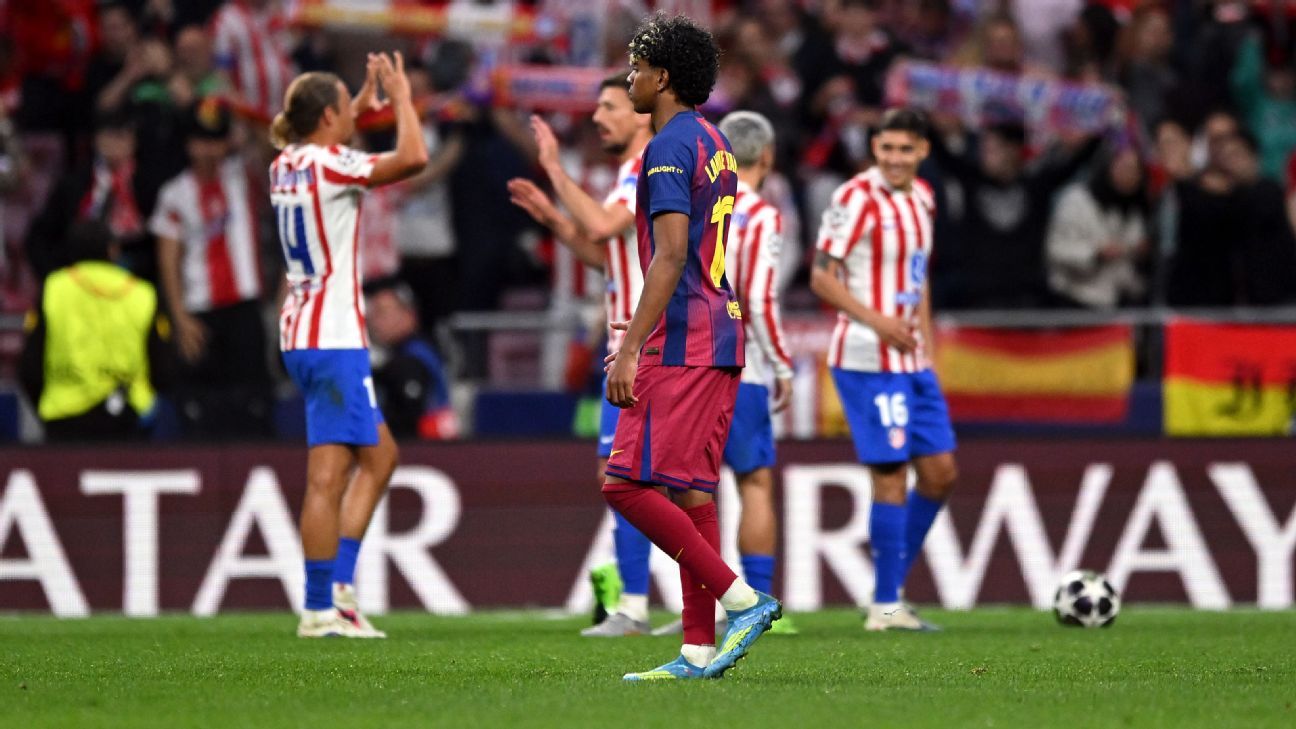
By halftime, Barcelona had created five big chances, according to Opta. Yamal had scored one of them and created three others, for Olmo, López and Torres. But they were still behind in the tie. Their 2-0 defeat at Camp Nou last week had given them so much to do. Even Lamine’s magic hadn’t yet been enough.
In the second half, there were more heart-in-mouth moments for Atlético — Torres had a goal disallowed for offside, and Olmo shot over the bar when well placed — but Barcelona never quite recovered the Yamal-led momentum of the first-half push.
Eric García‘s late red card, for a last-man shirt pull on substitute Alexander Sørloth, made the task that much harder. It was Barcelona’s second red card of the tie, after Pau Cubarsí’s early dismissal last week, two sendings off which have complicated an already difficult task. In all competitions, Barcelona have received eight red cards this season and three of them have come against Atlético.
In eight minutes of added time, Flick resorted to throwing Ronald Araújo up front, and Barça were almost rewarded when he headed over the bar in the 97th minute. After that, there was time for one last Yamal dribble, a cross to the far post towards Araújo, and it was game over.
“We played well, and we gave everything,” Frenkie de Jong said. “We tried. The feeling is that luck wasn’t on our side. We have to keep going, we’re going in the right direction. With one player fewer, it’s always more difficult.”
Simeone and Atlético’s Champions League record against Barcelona is impeccable, advancing in the quarterfinals in 2014, 2016 and now in 2026. The last two times, Atlético reached the final, only to lose to rivals Real Madrid.
This current edition is a more exciting and more vulnerable team than their reputation — and that of Simeone — might suggest. Already well adrift in LaLiga, they have a Copa del Rey final on Saturday against Real Sociedad — and then will be able to focus all their efforts on this competition.
As for Barcelona and Yamal, their season is almost certain to end with a second consecutive LaLiga title, but hopes of a first Champions League win since 2015 will have to wait another year.
“The next step is to win LaLiga,” said Flick. “We are on the way. It’s not done yet. It’s a big dream to win the Champions League. We have a young team and they can and will improve.”
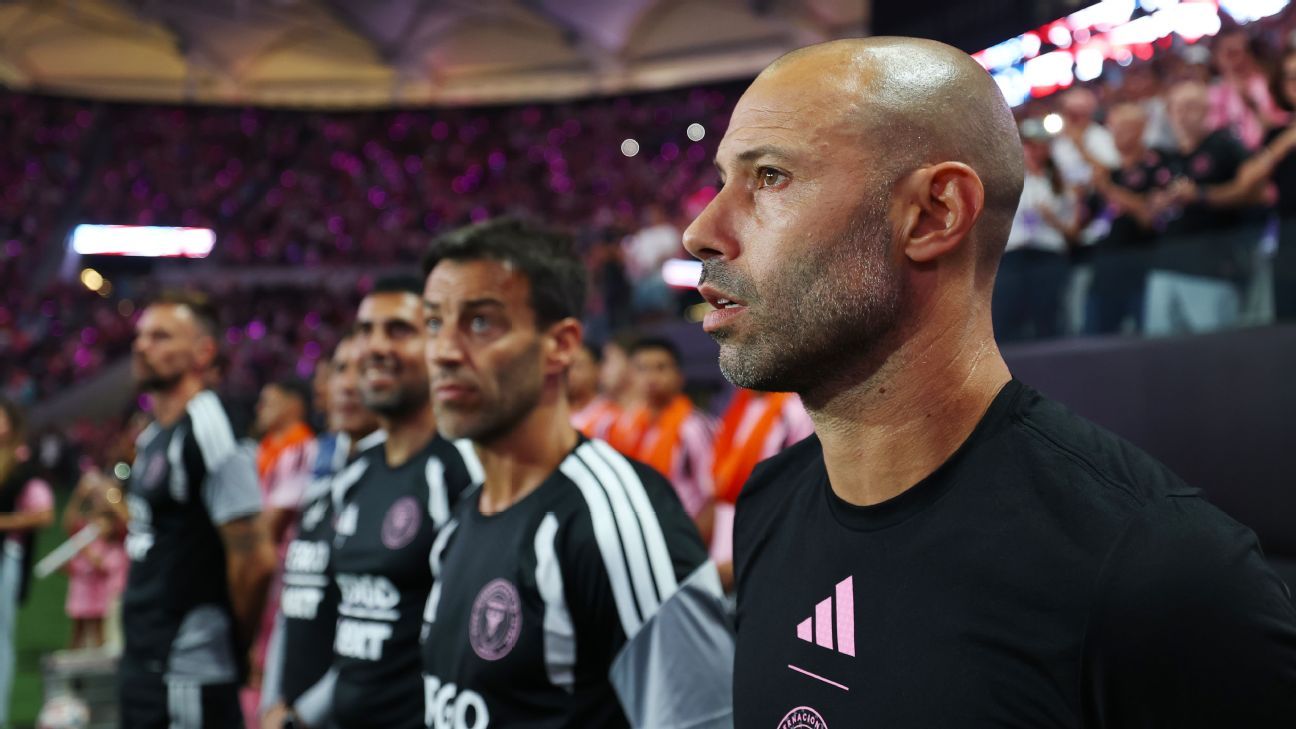
Mascherano officially communicated his decision to the club following Saturday’s 2-2 home draw against the New York Red Bulls, a source confirmed to ESPN.
The club said that Guillermo Hoyos will take over as head coach of the first team for “the upcoming matches,” moving over from his current role of sporting director.
“I want to let everyone know that, for personal reasons, I have decided to end my tenure as head coach of Inter Miami CF,” Mascherano said in a statement.
“First and foremost, I would like to thank the Club for the trust they placed in me, every employee who is part of the organization for the collective effort, but especially the players, who made it possible for us to experience unforgettable moments.”
Mascherano, a former teammate of Miami star Lionel Messi with Argentina and Barcelona, spent almost a year and a half at the helm after replacing Gerardo “Tata” Martino in November 2024.
The former Argentina under-20 coach led Inter Miami to the Concacaf Champions Cup semifinal and the Leagues Cup final, and he made history when lifting the MLS Cup during his first year with the club in 2025.
Miami is third in the Eastern Conference through seven games of the 2026 season but exited the Concacaf Champions Cup via a loss to Nashville SC.
The move comes not even two weeks after Inter Miami opened its new stadium near Miami International Airport. The club has tied its first two matches in the new facility.
“Javier will forever be part of this Club’s history and will always hold a special place in the Inter Miami CF family,” Inter Miami owner Jorge Mas said. “Not only for being a key part of unforgettable achievements, such as winning the MLS Cup and the team’s historic performance at the Club World Cup, but also for the example he set through his dedication and daily work leading the team.
“We respect his decision and are deeply grateful for everything he contributed, wishing him nothing but the very best in his professional and personal future.”
Hoyos comes into the role after working as a coach and sporting director in leagues across the world including Liga MX and serving as Bolivia national team head coach. Chief soccer officer Alberto Marrero will assume Hoyos’ previous responsibilities as sporting director of the club.
While it goes without saying that lifting the FIFA World Cup trophy aloft remains the ultimate prize in soccer, there is a far more important contest taking place among the qualifying nations as we continue to hurtle toward the tournament opener on June 11.
Naturally, we are referring to the battle to reign supreme in the style stakes at this summer’s tournament in Canada, Mexico and the United States, which is already raging across the continents before a ball has even been kicked.
Now that the playoffs are settled and all 48 of the World Cup qualifiers are formally confirmed, it’s time to thoroughly examine the home and away kits they intend to parade on football’s grandest stage.
It’s fair to say that the away kits are ruling the roost this time as designers let their creativity flow without the need to adhere to strict, traditional home colors and templates. We’ve got jerseys inspired by folk art, iconic buildings, local culture, flags, textiles, animals and even surrealist painters.
Heavy hitters Nike, Adidas and Puma boast the vast majority of kits on show, but there are a few choice entries from other, bijou sports brands who are about to have the fruits of their labors scrutinized by a watching global audience of millions.
With a couple of months still left to go until that opening game in Mexico City, several participating nations are yet to finalize their World Cup wares: Bosnia and Herzegovina, Iraq, Iran, Jordan, Panama, Tunisia and Uzbekistan are all still to unveil their tournament home and away kits, while Curaçao are yet to cook up a home kit for their first-ever World Cup appearance.
So we are still waiting for the full lineup of 96 home and away jerseys for all 48 competing nations. However, most of the kits have now been officially released and, with that, it’s time to rank them all!
Alas, even the fabled Adidas trefoil cannot do much to elevate what is essentially a plain white training shirt with bog-standard maroon trim. The Arabic name for Qatar (قطر) is printed on the back of the neck, but that — quite literally — is it.
The Swiss have impressed in recent years by releasing interesting conceptual kits inspired by Alpine railway stations and even the country’s high-tech digital passports. However, they will be arriving at the 2026 World Cup with an alternate jersey that is as green as it is nausea-inducing — i.e., very.
Scrappy stuff from the co-hosts, whose off-putting splattered shirt looks like it’s been worn while re-grouting the bathroom. Just straight-up awful.
Not to be confused with the All Blacks, their famous rugby union team, New Zealand’s monochrome home kit has a soft Māori fern motif in the material to help cement that important cultural link to the islands.
The shirt is plain, but we do like the inspirational motto stamped under the collar: Soñar, Trascender y Hacer Historia (“Dream, Transcend and Make History”). Hopefully it spurs the Tri on to equaling or even beating their best World Cup performance, which came in 2006 when they made it through to the round of 16.
76. Qatar home (Adidas)
A perfunctory maroon design that is saved from being an entirely generic template kit by the zigzag strip running down the center of the shirt, inspired by the Qatari flag.
The triangular print graphic that wraps around both Cape Verde’s new home and away shirt is inspired by the interconnecting flight paths that run between all of the African nation’s 10 islands. However, beyond that neat little detail, it’s all a bit generic.
It’s white, with a clunky red bar across the chest and a large Turkish flag stamped directly in the center of it all. We’re not saying that zero imagination went into the design process, but it certainly wasn’t much more than that.
73. Switzerland home (Puma)
Switzerland have failed to capture our imagination with a home kit release since roughly the dawn of time, and the latest edition is not about to change that. It’s a vast improvement on the away kit, but it is guilty of an equally grievous sartorial sin: being desperately, desperately boring.
72. Cape Verde home (Capelli Sport)
Much like the white away shirt, Cape Verde’s home shirt is covered in an all-over print inspired by the flight routes between the airports on all of the country’s 10 islands. While we’re not exactly wowed, the home variant ranks slightly higher by virtue of being a marginally more interesting colour.
Minimalistic bordered on bland, the Saudi away shirt is retro-adjacent with basic dark green and gold trim. There is a hatched pattern in the fabric that is supposed to resemble traditional Arabic weaving, but it does little to excite.
Haiti’s home and away shirts have the same layout, with the latter rendered in white and pale gray. The design is steeped in national pride with images of cinder cone mountains and palm trees, but perhaps the most unusual detail is the illustration of a group of Haitian freedom fighters who are flying their flag of independence.
We can see what Puma was aiming for here, but we sadly must conclude that they missed the mark entirely, with an ostentatious graphic design supposedly inspired by the beautiful Bohemian cut glass for which the Czechs are historically famous. Sadly, the shirt reflects precisely none of that delicate artisanship.
Slightly less on-the-nose than the home shirt, Egypt’s white away jersey actually doesn’t have much in the way of standout detail other than the thick black crew collar and a faint, grayed-out pattern made up of cross-section diagrams of a pyramid. The parade of seven stars over the EFA crest denotes how many times the Pharaohs have been crowned champions of Africa.
67. Türkiye home (Nike)
Nike’s primary design quandary when cooking up Türkiye’s kits is merely where to place the iconic swoosh logo each time. The Crescent-Stars have once again been plied with two dreary templates — one white, one red. A graphic reminiscent of peacock feathers has been added for a bit of extra zest, but not much.
66. Canada home (Nike)
Probably the weakest of the home nation kit sets, Canada’s home shirt is a modicum more stylish that their splotchy away variant with the silhouette of the maple leaf used to create a compelling quartered design.
65. Haiti home (Saeta)
While hardly the snazziest kits on display at the World Cup, we do have to applaud Haiti for attempting to cram as many patriotic images of their homeland onto their kit as is humanly possible. The volcanos, palm trees and images of Haitian independence definitely look better against the oceanic blue background of the home shirt.
It might be plain, but we really like the particular shade of orange-tinted gold used here. This jersey would look equally fitting if worn by the country’s national men’s rugby union team, the Wallabies.
The primary Senegal shirt is inspired by the famous old “Car Rapide” buses that are covered in hand-painted designs and used to whiz people around the streets of Dakar. However, a lot of that vibrancy was lost with the decision to fade down the graphics on the jersey, leaving it looking rather washed-out.
Though the manufacturer’s blurb suggests Austria’s new home kit design is “deeply rooted” in the country’s adventurous spirit, we’d posit that there is actually nothing remotely intrepid about it at all. It’s a serviceable red and black template, and nothing more.
Released ahead of the 2025 Africa Cup of Nations, Congo’s away kit sees the light blue and white palette of the home jersey flipped with the zebra skin print replaced by a graded diamond pattern that rises from the lower hem before fading out.
Paraguay are celebrating reaching their first World Cup in 16 years with what is unfortunately a fairly mediocre shirt. The red stripes are constructed using a neat stippled effect, but the design just looks like a half-baked doodle.
With a design inspired by Kwaku Ananse, a figure from West African folklore often depicted as a spider, the new Ghana home shirt has a multicolored web scribbled all over it that emanates out from the central Black Star crest. It’s one of the wilder designs on show at the tournament and might divide opinion, but we suspect many will appreciate the madness.
When it comes to international football kit design, some things you can just go ahead and hang your hat on. Croatia’s unfaltering palette is as close to enshrined as it’s possible to get: red and white home, moody blue away. And so shall it be forever and ever.
An aggressively bright orange shirt is speckled all over with a cacophony of animal print patterns. There are also flecks of green under the arms and dots of white in the various logos to complete the triptych of national colors. Hardly subtle, but we like the energy.
56. Ecuador away (Marathon)
Ecuador are punching well above their weight with a lean, svelte polo-style shirt in navy that is accented with gold detailing and a textured knit in the material lifted from the lines and angles of their EFF federation shield.
55. Egypt home (Puma)
While the overall design isn’t particularly earth-shattering, we do like the deep, regal shade of red used for Egypt’s World Cup home shirt. The frontage is gussied up with a star-shaped graphic that combines the Great Pyramids with the ankh, an ancient symbol of life and immortality.
You tend to know what you’re getting when it comes to Sweden’s home kit, and after branching out with a rather lovely pale yellow shirt for 2024, we’re back on a familiar footing again this time around.
Rudimentary stuff from Scotland here, whose home kit is dark blue and white with a Saltire cross pattern formed in the fabric. Not the most inspiring shirt the Tartan Army will ever wear, but we suspect it’ll do the job.
They might have missed out last time around, but Colombia are back at the World Cup with a fairly straightforward yellow home kit in tow. Closer inspection reveals a butterfly motif in the material that serves as a tribute to Colombian novelist Gabriel García Márquez, who frequently used the insects in his work to symbolize hope and rejuvenation.
The Atlas Lions’ away kit is white with a light sand-colored pattern that forms a central bib down the front of the jersey. The ornate line drawing is inspired by the intricate designs used to decorate traditional Moroccan tiles, rugs and textiles.
50. Czechia home (Puma)
Conceived as a tribute to the Puma shirts worn by the 1996 Czech side that finished as runners-up at the European Championship, this modern equivalent features similar embroidered taping that has been relocated from the sleeves to the collar and cuffs. We’re not sold on the button-up collar, but otherwise, we like what we see.
Portugal’s 2026 home kit channels the energy of the ocean in the hope that the team wearing it will “make waves” on football’s biggest stage this summer. We can forgive the tenuous pun because the shirt itself is actually rather nice.
48. Senegal away (Puma)
Senegal’s new away kit is nowhere near as cluttered as the home jersey, with the national tricolor of green, yellow and red on full display. There is also a vertical panel that runs down the center of the shirt that contains a pattern inspired by tribal textiles. Note the second star which has been added above the crest to represent victory in the AFCON final in January, despite the decision by CAF to strip the country of its title and award it to Morocco.
As bright and bold as you might expect, South Africa’s canary-yellow home shirt draws inspiration from the similar design worn by Bafana Bafana at their 2010 home World Cup — the thought being that it might help bring the entire nation together once again.
46. Paraguay away (Puma)
A mélange of blacks and blues make up a shadowy camo pattern. The monochrome white logos are a nice contemporary touch but as with Paraguay’s new home kit, but it lacks much in the way of visual staying power.
45. Australia away (Nike)
A lush watercolor gradient sees green-blue base notes give way to a bright orange-pink burst around the collar and shoulders. The design is supposedly inspired by the intense colors of sunrise over the outback, and we can certainly see what they were going for.
44. Congo DR home (Umbro)
DR Congo’s sky blue home jersey has a central band of zebra skin. It’s lovely, although it sits slightly incongruously given that their team nickname is the Leopards.
43. Austria away (Puma)
Here’s a kit that has steadily grown on us since its release. Austria’s unorthodox away kit has a minty green marble effect laced with hyper-saturated pink and purple veins and then as is that wasn’t enough, they’ve gone and overlaid a geometric golden arch pattern with the whole thing intended to conjure images of the ornate tables in traditional Viennese coffeehouses. There’s a lot going on, but it’s all starting to jell for us.
Red, black and yellow with a flame theme for what feels like the fifth successive home kit, the Red Devils will at least look suitably infernal at the 2026 World Cup. It’s decent, but we’ve seen it all before.
The final away shirt to be produced for Germany by Adidas before Nike take the reins from 2027 is a bit of a letdown. Rather than celebrating their 70-year relationship with Die Mannschaft, Adidas have trotted out a design that has the distinct whiff of “off the peg” about it. It’s fine, but we expected more.
40. Saudi Arabia home (Adidas)
A dark, forest-green base provides a verdant bed for a pattern with purple accents that is influenced by traditional Arabic geometric decoration. After years of boring template kits, it’s nice to see the Saudis attempting something a bit different once again.
39. New Zealand away (Puma)
A lovely little kit inspired by Hau, which is the Māori word for “wind.” As such, the jersey is covered with swirling clouds intended to symbolize the four winds that have brought the team together. Very stylish.
Japan’s home shirt is instantly recognizable in deep blue, red and white. There’s always a clever twist and this time it arrives in the form of a concentric ribbed pattern that occupies the entire center of the torso and resembles the haze that forms on the horizon between the sky and sea.
The basic template is formed from a chalky white base with green-and-red trim but the faded sandy gold stripes that appear on the upper chest are apparently inspired by Algeria’s arid deserts and rocky mountains. The choice of crest is a little confusing with the use of a simplified “Algeria” roundel rather than the usual (and far superior) Algerian Football Federation emblem.
36. Portugal away (Puma)
Awash with nautical whimsy, Portugal’s new away kit is white with an azure blue wave crashing over the top. The rolling surf is then split into two hemispheres with a plunging V-shape hemisphere that sits slightly awkwardly across the belly. It’s a tad messy but at least they attempted something a bit different.
35. Croatia home (Nike)
It might be basically unchanged for 30-plus years and become hopelessly predictable as a result, but it simply wouldn’t be a proper World Cup without that iconic Croatian checkerboard on show. The central clearing is this year’s minor design alteration — which is a vast improvement on 2024’s comically oversized blocks.
34. Sweden away (Adidas)
Once again, Sweden have rolled out a blue and yellow away kit to pair with their yellow and blue home kit, but the 2026 model does at least have a little more depth to it. The glacial blue base is overlaid with a 1970s-style Scandi ripple pattern in vertical stripes along the length of the torso.
Inspired by the tiger and its skill as an ambush hunter, the red-and-black Korean home shirt has a marled fur print suffused into the material that will hopefully induce the same ruthless attacking prowess from their national football team.
32. Colombia away (Adidas)
Seemingly always equipped with a stylish away kit, Colombia’s alternate jersey this time around is ultramarine blue and zingy lemon yellow. The wavy columns of lozenges do have a lovely aquatic “shimmer” to them.
A fairly obvious attempt to re-create the aesthetic of the 1990s Umbro retro kits so beloved by England fans. It does feel as though the design process entailed scanning every England shirt from 1984 to 1994 into a computer in order to create the precise mathematical halfway between all of them. In fairness, it does look so much better with the contrasting red names and numbers applied.
Imbued with garra charrua (the Uruguayan fighting spirit), this ultra-prim home kit is modelled on several of the classic Celeste shirts worn down through the ages. The immaculate white polo collar feels classy, as do the refined touches of navy trim.
A return to the oversized flag graphic that adorned Norway’s kits in 1998, the last time they appeared at a World Cup. The entwined graphic visible within the cross itself is inspired by the wood carving found on the 12th-century Urnes stave church, which dates from the Viking era.
Having gone with a two-tone red-and-yellow design for 2024, Spain have chucked dark blue back into the equation for 2026. The block sleeves help to break up what is a fairly unpretentious design though the delicate pinstripes on the torso offer some much-needed visual texture.
Given the home shirt is plastered in red-and-white stripes, it’s perhaps inevitable that the corresponding away shirt is spangled with stars in order to complete the full set. There are subtle hints of the USMNT’s iconic, patriotic 1994 World Cup attire, but it’s altogether more subdued this time around — and all the more stylish for it.
26. Scotland away (Adidas)
Clearly inspired by the national team’s candy-colored “Rosebery” uniforms of the early 1900s, Scotland’s energetic away kit also harkens back to some of the more dazzling kits worn through the 1980s and ’90s. However, rather than being overtly garish, the coral tone is refreshing and the navy pinstripes look sharp.
25. Ivory Coast away (Puma)
As is almost always the case, the Elephants’ away shirt is predominantly white though the 2026 design is far more elaborate than usual. Indeed, the torso is festooned with dappled patterns inspired by national flora and fauna, including elephants (naturally), baobab flowers and palm trees. It has the look of a 1970s vinyl tablecloth — and we rather like it.
Solid stuff from the Dutch, who really have opted for a “Maximum Oranje” theme to accompany their 2026 World Cup campaign. The design is clean and minimalist, with the focus put squarely on the national colors in lieu of any other extraneous detail beyond the iridescent black KNVB crest
As you might expect, Lionel Messi and his band of merry reigning world champions will be defending their title while wearing their familiar Albiceleste stripes. While the established design doesn’t offer an awful lot of creative leeway, there is a gradient present within the vertical bars that apparently references the three slightly different shades of blue worn by Argentina when they won their three World Cups in 1978, 1986 and 2022.
Designed in collaboration with the Jordan brand, Brazil’s new away kit is perhaps somewhat curiously inspired by the vivid coloration of the highly toxic poison dart frogs of the Amazon rainforest. The mottled graphic is black-and-navy with the contrasting trim overlaid in canary yellow and neon aqua. We also rather enjoy the oversized CBF federation crest and its wonky centralized placement.
21. England away (Nike)
The combination of rich red, navy and white, coupled with centralized logos and a jacquard pattern woven into the fabric (made up of lions and stars) amounts to a decent, solid effort from England. The only minor bone of contention is the unusual trapezoid neckline that seems to sit awkwardly on the collarbone and definitely works better with some Nike designs than others. All in all, it’s marginally more aesthetically pleasing than the home version and looks better in long-sleeve format too.
20. South Korea away (Nike)
Korea’s upbeat away kit is one of several floral designs evident at the 2026 World Cup and comes in a suitably appropriate purple lavender hue. The all-over blossom graphic lends a light and airy feel, while the glow-in-the-dark logos must surely go down as a World Cup first.
19. Netherlands away (Nike)
Basically a straight color swap of the home shirt, with a central band of orange added across the midriff in which a modernized, holographic KNVB crest is housed. Even more so than the home jersey, the Dutch away kit looks like it’s been airlifted in from the early 2000s, and we imagine your opinion of it will be directly shaped by how you feel about that era of kit design in general. For what it’s worth, we’re firmly in favor.
18. South Africa away (Adidas)
Bafana Bafana have an underrated hit on their hands here with a lush gold and forest green away kit. Along with the beautiful vertical stripes (made up of triangular hand-drawn tile patterns), the trefoil adds a smidge of luster amid an array of national federation logos including the Protea flower emblem, which has become an important symbol of national identity in modern South Africa.
17. Germany home (Adidas)
Germany have once again returned to the well and revived the yellow, black and red Bundesflagge diamonds of the late 1980s/early 1990s. This is the final home kit that long-time suppliers Adidas will be designing for Die Mannschaft before Nike take over next year and while it scratches the nostalgic itch, we were hoping to see a bombastic send-off rather than a pale cover version of a classic hit.
16. Norway away (Nike)
Norway have taken the strange choice of releasing a full “blackout” stealth kit for the World Cup that will almost certainly fall foul of FIFA’s stringent design/broadcast regulations. Regardless, it looks fantastic and the Viking theme present on the home shirt continues here with the application of Runic patterns on the sleeves and socks.
15. Mexico away (Adidas)
While it’s not a patch on the nostalgia-heavy Aztec design of the home kit, Mexico’s World Cup away kit is likely to prove equally popular on the terraces. The white shirt is clean and cool with minimal flag-themed trim and a zig-zag pattern referencing the Azoteas (external staircases that offer rooftop access) found on traditional Mexican buildings.
14. Algeria away (Adidas)
Looking like it was plucked directly out of the early 1980s — which was when Algeria first qualified for the World Cup, coincidentally — the 2026 away kit has a dapper, restrained retro feel without being too ostentatious. The two-tone green striped design looks effortlessly smart.
13. Ghana away (Puma)
Way more mellow than their frantic home shirt, Ghana’s alternate shirt comes in a pleasant shade of gold-yellow that is decorated with the kind of geometric pattern usually found on Kente cloth products, traditionally worn by royalty. The national colours are further represented in the flashes of red and green trim.
Les Bleus hardly ever put a foot wrong when it comes to dressing their national teams, and the 2026 home shirt can comfortably rub shoulders with their previous World Cup finery. The dark blue base tone is actually made up of various complimentary hues that have been hashed together in a diagonal pattern. We also love the pristine white fold over collar and the bronze textured logos that provide simple contrast and oodles of extra panache.
11. Morocco home (Puma)
While relatively understated at first glance, Morocco’s 2026 home shirt just gets nicer and nicer the more you stare at it. The material itself has a subtle texture to it, and the centralized crest looks fantastic. The real star of the show, however, is the Fes-style embroidered taping that adorns both the cuffs and the unusually shaped button collar.
10. Spain away (Adidas)
There’s a tangible opulence to Spain’s 2026 World Cup away kit which sees a rich creamy base overlaid with simple maroon and burnished gold decor. An ornate coiled vine pattern can be found woven into the fabric which is lifted from the gold-leaf illuminations used to embellish many ancient Spanish literary manuscripts. Put simply, there’s nothing not to like about it.
9. Belgium away (Adidas)
Belgium’s away shirt is inspired by their national federation crest and the Belgian surrealist artist René Magritte in the form of a pastel pink and blue abstract graphic that conceptually incorporates both by melding the “B” of the crest with the silver sphere shapes from Magritte’s 1928 work “La Voix des Airs.” Magnifique.
8. Brazil home (Nike)
Inspired, if only very loosely, by their great 1970 World Cup-winning side of Pele, Jairzinho and Rivellino, the latest Brazil home shirt is canary yellow with simple, chunky blocks of dark green trim at the collar and cuffs. The unusual notched neckline that Nike has applied to several of its kits looks good here and the geometric diamond pattern in the fabric is an abstracted take on the national flag. Looks even better when paired with the Selecao’s classic blue shorts/white socks combo too.
7. Argentina away (Adidas)
It would appear that Argentina’s relatively garish away kit has divided opinion among fans, but we happen to appreciate the unique design. The black shirt is covered all over in a tumble of foliage and fronds picked out in lighter blue shades that are inspired by the Fileteado Porteño folk art style that can be found adorning everything from buildings to buses to bicycles on the streets of Buenos Aires.
6. Mexico home (Adidas)
Obviously produced in homage to one of the greatest World Cup kits ever created, co-hosts Mexico have based their 2026 primary kit on the incredibly elaborate Aztec design worn by El Tri at the 1998 finals in France. It must be said that the contemporary reworking (which features an imprint of the Piedra del Sol, one of the most famous surviving Aztec sculptures) doesn’t quite have the same extraordinary level of pizzazz as the original but the effect is still very much felt.
5. United States home (Nike)
A throwback to the glory years of 1994, when the USMNT last hosted a World Cup. The red-and-white stripes are back though this time they have been applied horizontally across the shirt. Much like the ’94 precursor, the bands have also been given a clever wave effect to replicate the gentle ripple of Old Glory as it flutters in the breeze.
Another surefire smash among kit collectors, Curacao’s lemon yellow away shirt is positively awash in sunshine vibes. Inspired by the Caribbean island’s capital city of Willemstad and the colorful buildings that line the waterways in the Punda and Otrobanda districts, the dashes of pastel pink, turquoise and orange (matched with a tricolor trefoil) radiate in harmony to create a dreamy feel. We can’t wait to see what the home kit looks like.
3. France away (Nike)
You simply have to hand it to France; they know how to dress for a World Cup. Coupling nicely with their jazzy home shirt, the away variant comes in a minty shade of verdigris that is inspired by the copper cladding of the Statue of Liberty, gifted by France to the United States and dedicated in 1886 as a symbol of the cordial relationship between the two nations. The gorgeous metallic copper logos and dainty tricolore banding on the sleeve cuffs serve as the perfect finishing touches.
2. Japan away (Adidas)
Taking styling pointers from retro baseball jerseys, Japan have certainly hit it out of the park with their achingly lovely World Cup away kit. The soft, off-white shirt is lined 12 rainbow pinstripes — 11 to represent the team on the pitch and the 12th red central stripe signifying the wider Japanese football family. It’s proved to be an instant sellout, and it’s not hard to see why.
1. Uruguay away (Adidas)
There’s not a lot to separate the kits at the top of the order, but Uruguay’s wonderfully esoteric away kit just nudges it for us. The shirt is presented as a tribute to their history-making World Cup team of 1930, who won the inaugural tournament to become football’s very first world champions. The inky indigo shirt has a shimmering mantle around the neck in blue and electric orange which resembles ancient indigenous armor and is intended as a visual metaphor for the 2026 team’s desire to guard their ancestral throne. Very fantastical. Very, very cool.
LONDON — Manchester City know exactly when to be ruthless in a Premier League title race. If there was any doubt about that, they dispelled it during the eight minutes of stoppage time at the end of their 3-0 win against Chelsea at Stamford Bridge.
It was a passage of play that will only strike more fear into the hearts and minds of Mikel Arteta and his nerve-shredded Arsenal players as they prepare for what has become a potential title decider against City at the Etihad Stadium next Sunday.
If Arsenal win, they will move nine points clear at the top and banish the jitters that have seen them lose three of their past four games in all competitions — including last month’s Carabao Cup final against City — and take a huge stride toward a first title since 2004. But a City win would move them to within three points of the Gunners, knowing that winning their game in hand will almost certainly take them top on goal difference.
It is the goal difference that made their final eight minutes against Chelsea so compelling and instructive as to the mood within Guardiola’s squad.
City started this weekend seven goals behind Arsenal in the goal-differential column, but after Bournemouth’s shock 2-1 win at the Emirates on Saturday and City’s win at Stamford Bridge, the goal difference has been reduced to just three in Arsenal’s favor. That lead would be wiped out by a City win against Arteta’s side and a victory in their game in hand against Crystal Palace, though it would still be close.
So despite being three goals up as they entered stoppage time, City’s ruthlessness clicked in. The game was already won, and angry Chelsea fans were streaming out of the stadium, but the moment that the fourth official raised the board to signal the additional eight minutes seemed to kick Guardiola’s players into an extra gear. They peppered the Chelsea goal like a team chasing a late equalizer or winner; Erling Haaland desperately tried to score his first goal of the game.
The home side found itself penned in by a City team knowing the significance of every additional goal it could score. In the end, City were unable to add to their winning margin, but the message was clear that every goal counts and that they will not waste the chance to score them.
“I have not given the players the message before the game about goal difference, but I like it that they are 3-0 up and still trying to score more,” Guardiola said. “I like it when Savinho is making four crosses and the players are trying to score, but I don’t know if [goal difference] will make difference.”
Arsenal are not showing the same ruthlessness. They are finding the title pressure to be suffocating because a possible quadruple could now become a big fat nothing, and three goals in their past four games highlights how everything is beginning to tighten up for Arteta’s players.
City have scored nine goals without conceding in three games since their UEFA Champions League defeat against Real Madrid last month. They have been energized by the tension, while Arsenal have allowed it to paralyze them.
Even though this game was uneventful during the first half, City always looked to be in control against a Chelsea side low on confidence and without vice captain Enzo Fernández, who was serving the second game of a club suspension for voicing a desire to live in Madrid.
play
1:53
Laurens: Chelsea’s project with Rosenior is failing
Julien Laurens slams Chelsea’s performance vs. Manchester City and believes Liam Rosenior is out of his depth.
But City pulled clear by simply stepping up the intensity at the start of the second half. They went in for the kill, and Rayan Cherki was the instigator, creating two goals in the space of six minutes for Nico O’Reilly and Marc Guéhi. One was a pinpoint cross for O’Reilly, the other a perfectly weighted pass for Guéhi, with both deliveries epitomizing Cherki’s quality and impact since his £35 million summer transfer from Lyon. His assists against Chelsea took him to 10 this season.
Cherki, Guéhi and Antoine Semenyo have all arrived at City since last summer, and all were proven performers — players with a track record in Europe or the Premier League. Chelsea, by contrast, have generally signed project players such as Jamie Gittens, Liam Delap and Alejandro Garnacho, who are nowhere near the finished article.
This was a win for pedigree over potential — the same could be said of Guardiola vs. Chelsea coach Liam Rosenior. It is difficult to see Chelsea’s approach ever bearing fruit as consistently as that of City, who sealed a 3-0 win when Jérémy Doku scored after dispossessing Moisés Caicedo at the edge of the penalty area.
It could have been more for City, but their momentum is such that Arsenal will be fearing the worst at the Etihad. The Gunners can, of course, change the narrative by beating Guardiola’s side next week. But until they develop the same kind of ruthlessness and desire that typifies this City team, it seems that the title race is only going to end in City’s favor.


 Man City back in title race, but Arsenal look better than they have in a long time
 Bayern Munich seal title with emphatic win
 Luck turns against Chelsea as Manchester United win